House Systems in Astrology
Revised . First published .
Astrology house systems divide your birth chart into 12 sky sectors that show where your planets act in daily life. Because the Earth tilts, astrologers can slice the sky by time, space or zodiac sign. That choice explains why your planets sometimes shift houses when you try a new chart calculator.
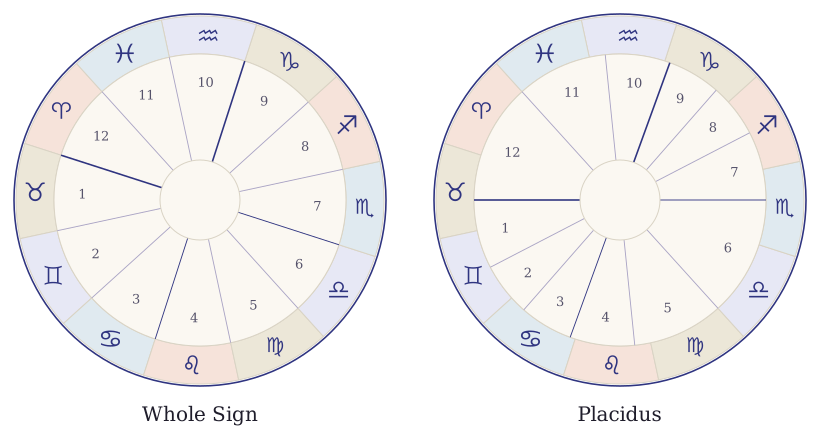
House systems compared
| System | How it divides the chart | House sizes | Above 66° latitude | On this site |
|---|---|---|---|---|
| Placidus | Time: the daily arc of each degree above and below the horizon | Unequal | Can't be drawn | Default |
| Whole Sign | Signs: each house is one whole sign | 30° each | Works | Offered |
| Equal | 30° steps from the Ascendant | 30° each | Works | Offered |
| Porphyry | Each quarter between the angles cut in three | Unequal | Works | Offered, used above 66° |
| Koch | Time, from the Midheaven's rising at the birthplace | Unequal | Can't be drawn | Not offered |
| Regiomontanus | The celestial equator in 30° parts | Unequal | Works, very stretched | Offered |
| Campanus | The prime vertical in 30° parts | Unequal | Works, very stretched | Not offered |
The 66° latitude limit for Placidus
This 17th century time based method is what most chart websites use by default. It times how long each degree needs to rise from your Ascendant, the zodiac degree coming up on the eastern horizon. That path ends where your Midheaven stands, and your Midheaven is the highest point in the southern sky. Some zodiac degrees never rise or set once you're beyond about 66° latitude, so the math breaks down and your houses lose their shape.
House system: whole sign
For centuries, ancient astrologers used this straightforward layout, and we often recommend it for beginners. Find which sign in the zodiac holds your Ascendant. Your 1st house covers that whole 30° sign, spanning 0°00′ through 29°59′. The sign after that becomes your 2nd house, and the pattern continues around the wheel. Because every house is simply one whole sign, this method still works near the poles.
The Equal house system
You may want every house the same size, starting exactly on your rising degree. Your Ascendant sitting at 14°23′ Gemini puts your 1st house cusp right there, the dividing line where one house starts. The 2nd house begins 30° further along, at 14°23′ Cancer, and each house after that follows the same pattern. Any latitude on Earth works cleanly with it.
The Koch house approach
This time based method was developed in the 20th century, and it's popular with psychological astrologers. What it measures is the sky's rotation time on your birth date, running from the degree of your Midheaven to the degree of your Ascendant. After that, the calculator divides that time span into 3 equal parts. It depends on rising times, so it fails as well when your birthplace lies beyond 66° latitude.
The Porphyry house approach
It's the oldest method with both anchors, placing the 1st house on your Ascendant and the 10th house on your Midheaven. Rising times aren't something it tracks. Instead of rising times, it measures the gap in zodiac degrees between those 2 points, then cuts that gap into 3 equal slices. The result is a chart that holds your exact sky angles and doesn't fail in the far north.
The Regiomontanus house approach
This 15th century space method won favor with Renaissance astrologers, and traditional practitioners still apply it to answer specific timed questions. The line over Earth's equator is cut into 12 segments of 30° each. Those lines get projected onto the ecliptic, the sky path the Sun appears to travel. At moderate latitudes, the chart you get looks close to Placidus.
House system: Campanus
The sky gets divided directly around your birthplace by this 13th century space method, like slicing an orange overhead. Starting at your eastern horizon and passing through the point straight over your head, that circle divides into 12 equal 30° wedges. Those wedges are then projected onto the ecliptic. Starting from your local sky dome, it can leave some houses on your chart looking very wide.
Which house system should you pick?
These methods differ because you're putting a round, tilted sky on a flat wheel. At the equator, zodiac signs rise at nearly the same speed, which means all 7 methods produce almost the same chart for you. The Sun's path tilts more toward the horizon the farther north or south your birthplace sits. Some houses in time and space methods span 2 or 3 signs, but sign and equal methods hold every house to 30°.
Our advice for your 1st chart reading: pick the method that matches the books or astrologers that you follow. You'll usually find modern psychological books assuming Placidus, while astrologers in the traditional and podcast circles often read from Whole Sign. If your birthplace lies north of 60° latitude, including places such as Alaska, Scotland or Scandinavia, leave Placidus and Koch aside so your houses stay readable. Settle on your layout with these 3 steps:
- Use Placidus for your birth chart unless you were born close to the Arctic Circle.
- In Whole Sign, enter the same birth time once more and note any planet that changes houses.
- Compare the descriptions of both houses for that planet, then keep whichever layout matches your life experience.
Common questions
Do my zodiac signs or planet degrees change with different house systems?
No. Whatever calculation you select, your planets keep their exact zodiac degrees. Say the Sun stood at 24°12′ Gemini at 3:15 PM at your birth; each chart method shows it at 24°12′ Gemini. The degrees of your Ascendant and Midheaven stay put as well. Around those fixed sky positions, only the house dividing lines shift.
Why does Placidus leave a whole zodiac sign out of my house cusps?
Stretching wider than 30°, a house can swallow a whole zodiac sign inside its borders so the sign never touches a cusp. Every chart holds 12 houses and 12 signs, so the sign opposite one touches 2 cusps in a row. For astrologers, an enclosed sign often means a quiet trait, one that develops later in life.
In Whole Sign or Equal, why did my Midheaven end up outside the 10th house?
With unequal methods, the 10th house cusp holds your Midheaven exactly. Whole Sign and Equal instead step through the houses in strict 30° increments from your Ascendant, so your Midheaven can float freely in the southern sky. It can land in the 9th, 10th or 11th house depending on your latitude, and astrologers keep reading that spot as your public career point.
If my exact birth time is unknown, which house system will work?
Every one of the 7 methods calls for a birth time, since the eastern horizon shifts by about 1° for every 4 minutes. No recorded time means no Ascendant or Midheaven can be calculated. If you have no hospital record, astrologers often use your Sun sign for the 1st house and work with 30° houses as a temporary layout.